


Cleanroom Lighting vs. Conventional Lighting

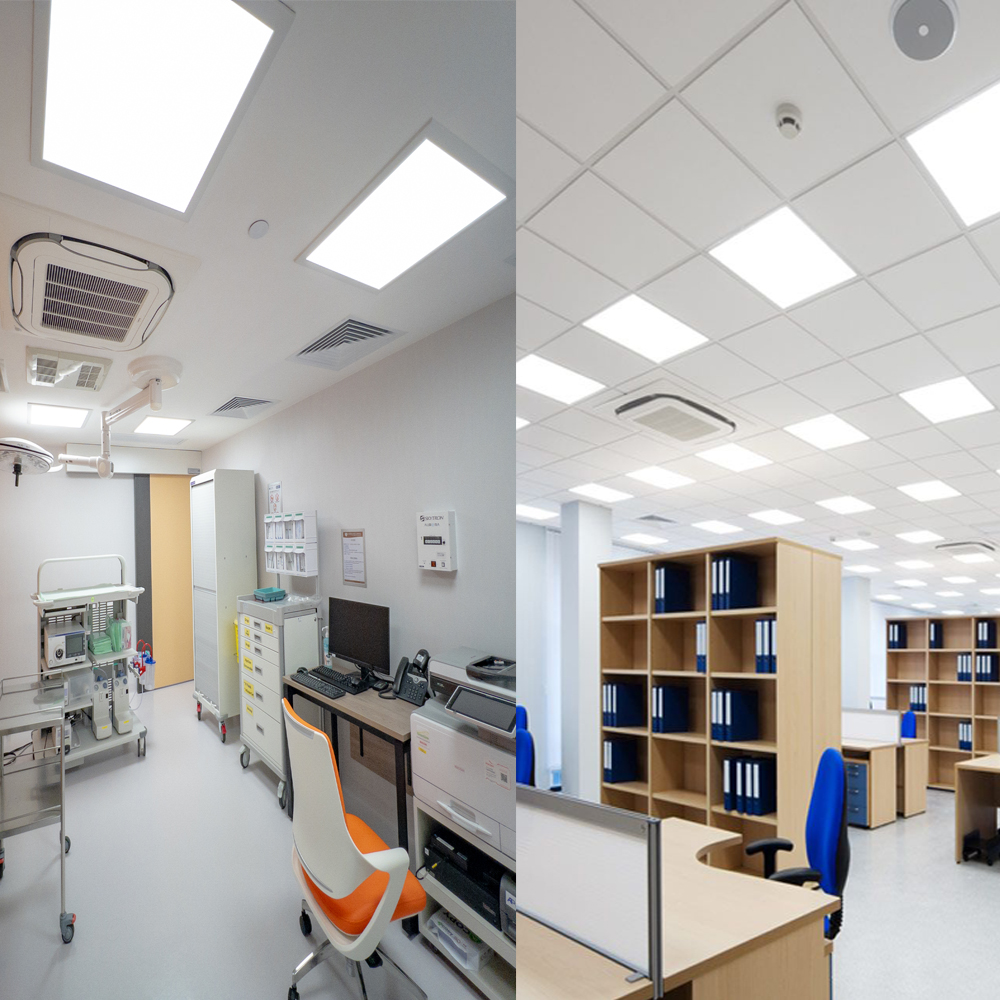
Comparison across six dimensions: Material, Shape and Structure, Optics, Antibacterial, Installation, Maintenance
Core design differences: Cleanroom lights prevent dust accumulation, are resistant to disinfectants, and are sealed without dead corners; conventional lights focus on low cost and general lighting, without cleanroom or dust-prevention designs
1. Material Differences
Cleanroom Lighting
1.1 Housing: 304/316 stainless steel, thickened anodized aluminum, with a smooth polished surface, resistant to repeated wiping with 75% alcohol, hydrogen peroxide, and peracetic acid, without peeling or particulate shedding.
1.2 Seals: Food-grade silicone rubber / EPDM full-circle sealing rings, fully sealed with IP65 or above, preventing moisture and dust from entering the interior of the fixture.
1.3 Light-transmitting parts: Anti-static modified PC / optical-grade acrylic, aging-resistant, prevents dust adhesion through static, and is not easily corroded or cracked by disinfectants.
1.4 Internal components: Drivers fully encapsulated with glue, silicone rubber high-temperature wires, no risk of dust or debris shedding.
Conventional Lighting Fixtures
1.5 Housing: Cold-rolled iron sheet with paint, ordinary recycled ABS plastic; the paint peels and flakes when it comes into contact with disinfectant solvents, and the metal is prone to rust.
1.6 Sealing: No complete sealing ring, mostly IP20~IP40, only simple snap-fit assembly.
1.7 Light Transmission: Ordinary recycled PC material, no anti-static modification, prone to accumulating static dust, yellowing, and cracking.
1.8 Power Supply: Open bare-board driver, no potting, components are prone to dust and powder accumulation.
2. Appearance Structure
Cleanroom Lighting
2.1 The overall design is a fully flat, slim panel, with all corners smoothly rounded (R arc transition), no sharp right angles, no grooves, no heat dissipation fins, and no protruding clips.
2.2 Formed by integral extrusion/bending, with no seams on the exposed surfaces; all fastening screws are countersunk and sealed with caps, making screws invisible on visible surfaces.
2.3 The light-emitting surface is a single-piece integrated diffuser panel, with no grids, cutouts, or segmented grooves; the back of the luminaire is sealed without heat dissipation openings.
Conventional Lighting Fixtures
2.4 Multiple right-angle edges, frames with stepped grooves, heat-dissipating teeth, and protruding clips; the grille lamp comes with a metal mesh hollow structure.
2.5 Profiles are assembled in segments, with exposed joints; screws and locks are protruding.
2.6 Diffusion panels consist of multiple segmented pieces with seams, large heat-dissipation openings on the back, and exposed cavities.
3. Optical Performance
Cleanroom Lighting
3.1 Color rendering index Ra ≥ 80, inspection/pharmaceutical area ≥ 90, accurate color reproduction, meeting product appearance inspection requirements;
3.2 Glare UGR ≤ 19, diffuse reflection uniform light structure, working surface illuminance uniformity ≥ 0.7;
3.3 Low-heat light source, reducing thermal airflow disturbance to clean laminar flow, strictly controlling ultraviolet leakage, preventing photosensitive material degradation;
3.4 Low light decay, uniform color temperature in the same area, long-term stable lighting, reducing frequent replacements.
Conventional lighting fixtures
3.5 Ra 65–75, large color deviation, severe glare UGR >25;
3.6 Poor illumination uniformity, significant contrast between bright and dark spots;
3.7 High heat generation, no UV control, inconsistent color temperature, significant light decay.
4. Antibacterial Performance
Cleanroom Lighting Fixtures
4.1 The surfaces of stainless steel / antibacterial modified plastic are dense and smooth, not easy for bacteria to adhere, and have no corners that trap dirt and grime;
4.2 Seamless sealed structure, with dry interior cavities without water or dust accumulation, preventing the growth of mold and biofilm;
4.3 Can withstand routine sterilization with ozone, VHP, and disinfectants, with materials that do not release harmful substances.
Conventional lighting fixtures
4.4 Gaps and grooves are very prone to accumulating dust and water, becoming carriers for bacterial and mold growth;
4.5 When the painted surface comes into contact with disinfectants, it dissolves and releases organic substances, accelerating microbial reproduction, with no antibacterial modification treatment.
5. Installation Method
Cleanroom Lighting
5.1 In high cleanliness areas, flush-mounted installation is preferred. The lamp surface should be on the same level as the clean color steel ceiling, with no protrusions, and gaps should be sealed with sealant.
5.2 For ceiling-mounted models, the base should be equipped with a full-circle sealing gasket, and the cable entry holes should have waterproof gland seals to prevent dust from the ceiling interlayer from entering the cleanroom along the cables.
5.3 The layout of the lamps should avoid FFU air outlets and laminar flow areas, ensuring that the airflow is not blocked to prevent vortex dust accumulation.
Conventional lighting fixtures
5.4 Mostly protruding ceiling-mounted, pendant, and grille recessed with open gaps, wiring without sealing, cable holes exposed;
5.5 Installation does not consider airflow organization, arranged arbitrarily.
6. Maintenance Methods
Cleanroom Lighting
6.1 Rear-Access Maintenance: Remove the rear cover of the lighting fixture from the ceiling cavity (non-clean side) without entering the cleanroom. Maintenance does not allow dust or debris to fall into the clean space and meets GMP cleanroom standards.
Conventional lighting fixtures
6.2 Front-Open Maintenance: Open the light panel directly inside the room. When opening, accumulated dust inside falls directly into the room, without clean protection.
| Comparison Project | Cleanroom Lighting | Conventional lighting fixtures |
| Materials | Stainless steel / anodized aluminum, full rubber ring seal, anti-static light-transmitting panel | Thin sheet metal / ordinary plastic, simple splicing, ordinary light-transmitting material |
| Appearance Structure | Arc-shaped without grooves, seamless integration, hidden screws, no grille | Right-angle multi-slots, splicing gaps, exposed screws, hollow grille |
| Optical Performance | High visibility index, low glare, low heat generation, low ultraviolet | Low visibility index, high glare, high heat generation, no UV control |
| Antibacterial Performance | Smooth and antibacterial, sterilization-resistant, no hidden corners for bacteria | Easily accumulates dirt and breeds bacteria, not resistant to disinfectant corrosion |
| Installation Method | Same-level Embedded / Sealed Ceiling, Fully Sealed Inlet | Surface-mounted protrusion, incoming line hole without sealing |
| Maintenance Methods | Open the back cover of the ceiling without contaminating the clean area | The front panel indoors is removed, and accumulated dust is scattered inside. |